Budget Dual RTX 5060 Ti — NVIDIA P2P On vs Off Inference Benchmark
A reproducible benchmark of NVIDIA peer-to-peer (P2P) on vs off for tensor-parallel
LLM inference on a pair of consumer RTX 5060 Ti (16 GB) cards, running
Qwen3.6-27B-Text-NVFP4-MTP
under vLLM with NCCL cuMem P2P transport.
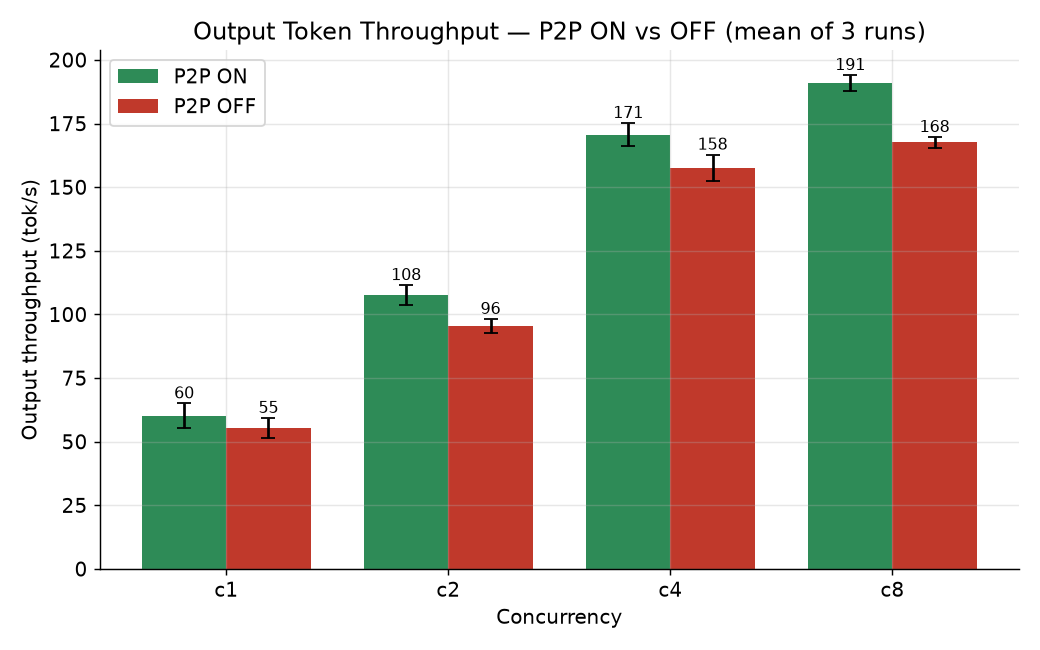
Each scenario was measured at concurrency 1, 2, 4, and 8, with 3 iterations per arm in an interleaved AB‑AB‑AB schedule (P2P_ON run, then P2P_OFF run, repeated 3×) to average out thermal drift and run-to-run noise.
TL;DR — On a Gen3 x4 link per card, enabling consumer-GPU P2P delivers a consistent +8% to +14% output-throughput uplift across all tested concurrencies, with lower latency and better tokens-per-joule. For a single-user inference box that rarely exceeds ~4–5 concurrent requests, this $1,000-of-GPU build is a genuinely viable setup.
📑 Every substantive claim in this report is backed by data. See the Evidence Appendix — each claim there links to the source file and shows the exact excerpt that supports it. Throughout this page, ⓘ evidence links jump you straight to the relevant proof. (Raw-data links open the files in the GitHub repository; the Evidence Appendix and charts are part of this site.)
Credits & resources
I did not figure this out in a vacuum. Huge thanks to the following — these are the resources I leaned on to get consumer-GPU P2P working and to design this rig:
- r/LocalLLM — “Quad 5060 Ti 16GB OCuLink rig” — the major inspiration for this whole build.
5p00kyy/club-5060ti— the club-5060ti repo: invaluable reference for running multi-5060-Ti setups.aikitoria/open-gpu-kernel-modules— the patched NVIDIA open GPU kernel modules that enable P2P on consumer GeForce cards. This is the driver that makes the “P2P ON” arm of this benchmark possible.- Model:
sakamakismile/Qwen3.6-27B-Text-NVFP4-MTPon Hugging Face — the NVFP4 + MTP model served throughout.
Table of Contents
- Results at a glance
- Throughput
- P2P uplift
- Latency — and the MTP caveat
- Energy efficiency
- Proof that P2P is actually being used
- PCIe link state — why this is Gen3 x4 (and not Gen4)
- What the telemetry tells us
- Is P2P even worth it for my use case?
- System, driver & patched kernel-module details
- Boot, GRUB & sysctl tuning captured at runtime
- Cost breakdown — why this is a budget build
- Reproduce it yourself
- Future work
- About me & a request
- Raw data index
- Evidence Appendix (claim-by-claim proof)
- Credits & resources
Results at a glance
Model: Qwen3.6-27B-Text-NVFP4-MTP
(NVFP4 weights, MTP speculative decode, 3 spec tokens)
· tensor-parallel-size=2 · kv-cache-dtype=fp8 · max-model-len=65535 ·
max-num-batched-tokens=16384 · gpu-memory-utilization=0.86 ·
attention-backend=TRITON_ATTN · disable-custom-all-reduce · NCCL 2.28.9 ·
NCCL_CUMEM_ENABLE=1.
All figures are the mean of 3 runs. Throughput in tokens/sec, latency in ms. Config evidence: ⓘ model/MTP · ⓘ vLLM args · ⓘ devices. Results evidence: ⓘ throughput · ⓘ latency/MTP · ⓘ power.
| Concurrency | Arm | Output tok/s | Total tok/s | mean TTFT (ms) | mean TPOT (ms) | p99 TPOT (ms) | mean ITL (ms) | Avg power (W) | tok/J |
|---|---|---|---|---|---|---|---|---|---|
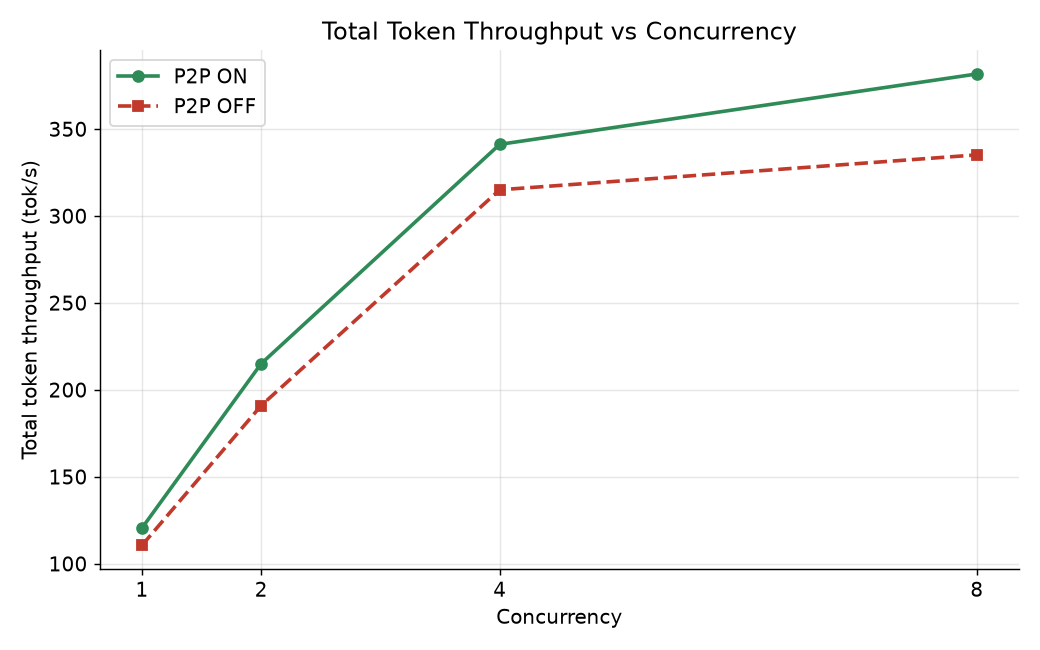
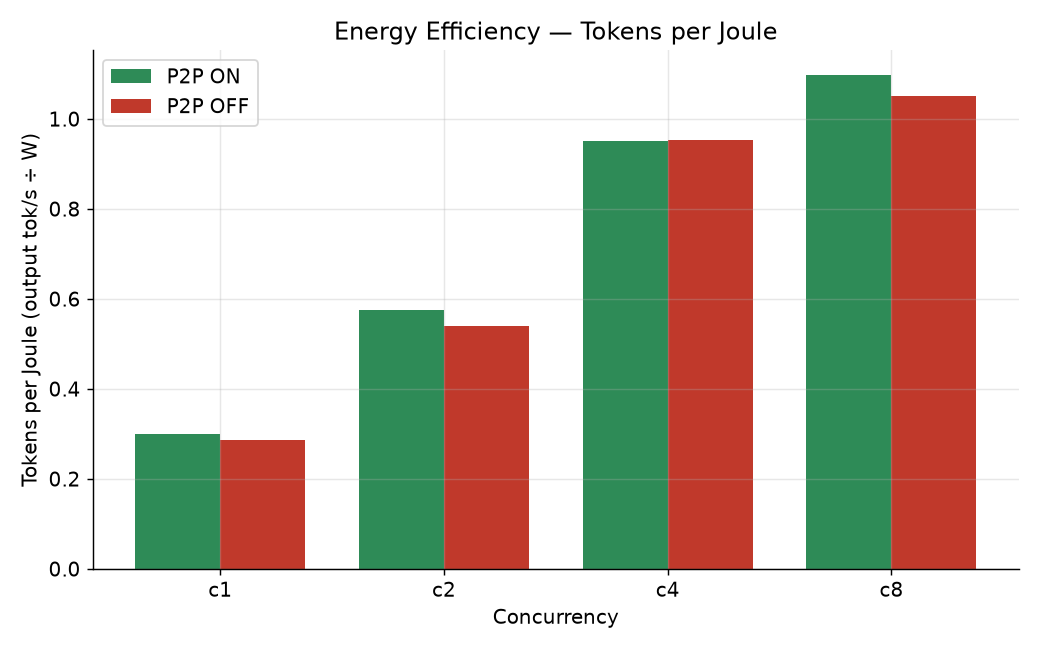
| 1 | P2P ON | 60.3 ±4.8 | 120.6 | 742 | 16.0 | 26.6 | 45.4 | 201 | 0.301 |
| 1 | P2P OFF | 55.3 ±4.0 | 110.6 | 945 | 17.3 | 30.4 | 47.5 | 192 | 0.287 |
| 2 | P2P ON | 107.6 ±4.0 | 215.2 | 890 | 17.6 | 32.5 | 51.3 | 187 | 0.577 |
| 2 | P2P OFF | 95.5 ±2.7 | 191.1 | 1062 | 19.5 | 42.0 | 55.1 | 177 | 0.539 |
| 4 | P2P ON | 170.6 ±4.6 | 341.3 | 985 | 22.1 | 46.5 | 61.5 | 179 | 0.952 |
| 4 | P2P OFF | 157.6 ±5.2 | 315.1 | 1179 | 23.9 | 45.6 | 68.8 | 165 | 0.954 |
| 8 | P2P ON | 190.9 ±3.2 | 381.8 | 16463 | 25.0 | 62.5 | 70.6 | 174 | 1.098 |
| 8 | P2P OFF | 167.6 ±2.1 | 335.2 | 18640 | 28.2 | 71.3 | 79.7 | 160 | 1.050 |
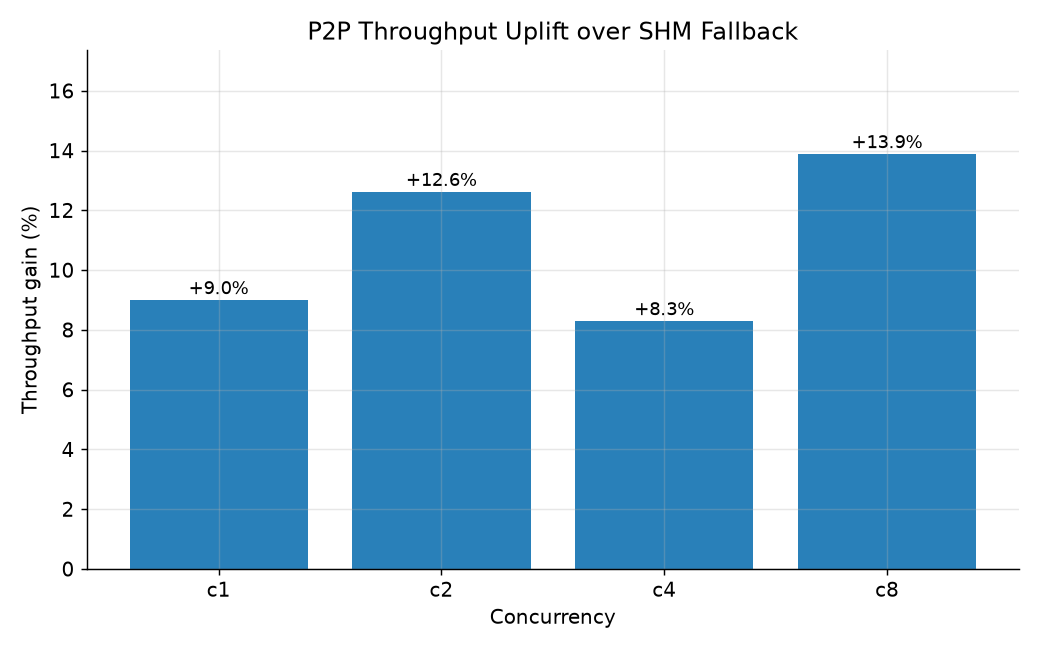
P2P output-throughput uplift: c1 +9.0% · c2 +12.6% · c4 +8.3% · c8 +13.9%.
ⓘ evidence
How to read these numbers (caveats up front):
- n = 3 per scenario. The
±is the std-dev across those 3 interleaved (AB-AB-AB) reps. With only 3 samples there’s real run-to-run variance — e.g. the c1 P2P-on runs were[64.0, 63.3, 53.5]tok/s — so treat the smaller deltas (c1, c4) as suggestive and the larger, lower-variance ones (c2, c8) as more solid. The direction (P2P on ≥ off) is consistent across all four. ⓘ raw per-run valuestok/Juses board power (nvidia-smi power.drawsummed over both cards), not wall power — so it excludes CPU/PSU/idle-rail overhead and is a GPU-relative figure.- MTP makes absolute tok/s workload-dependent. Inputs are fixed-length and deterministic so the P2P delta is apples-to-apples, but the absolute throughput won’t match a real chat trace. See the MTP caveat for ITL.
- TTFT at c8 is ~16–18 s because 16×8 = 128 fixed-length prompts are submitted at once against
max-num-seqs=8, so most requests queue — that’s queueing latency, not first-token compute. TPOT/throughput are the meaningful c8 metrics.- This is n = 1 system. One rig, one model, one driver build, one PCIe link state (Gen3 x4). The P2P delta here shouldn’t be assumed to generalize to other GPUs, link widths, models, or NCCL/driver versions — it’s a data point for this configuration, not a universal claim. The future-work runs (Gen4, 4-card) are intended to broaden it.
Throughput
P2P ON wins at every concurrency level. Error bars are the std-dev across the 3 iterations. ⓘ evidence: throughput data
P2P uplift
The relative gain from enabling consumer-GPU P2P over the NCCL SHM (shared-host-memory) fallback path. Even on a modest Gen3 x4 link the all-reduce traffic in TP=2 benefits. ⓘ evidence: uplift figures
Latency — and the MTP caveat
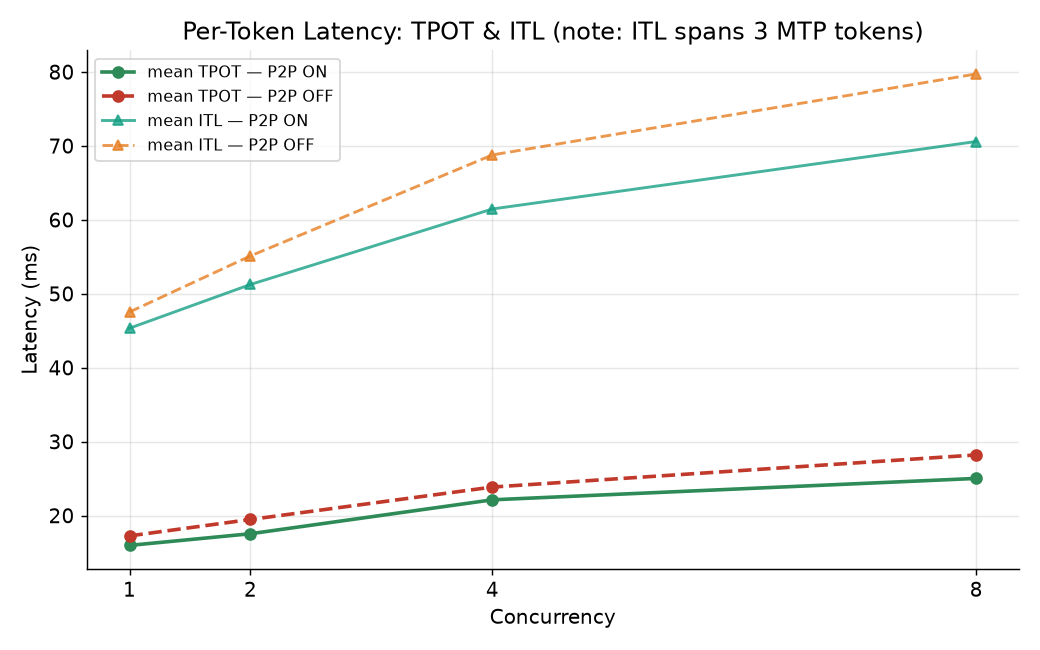
⚠️ Important note about the latency metric and MTP
This model runs with Multi-Token Prediction (MTP) speculative decoding configured with 3 speculative tokens (
speculative-config={"method":"mtp","num_speculative_tokens":3}).Because of this, the ITL (Inter-Token Latency) number is not directly comparable to the ITL you’d read on a non-MTP model. On a normal (non-speculative) model, the per-token latency metric measures the time to emit a single token. With MTP and 3 spec tokens, the engine proposes/verifies a block of up to 3 tokens at once, so the measured inter-token interval reflects the time between completing a whole batch of those 3 speculation tokens — not a single token. That makes the mean ITL (~45–80 ms) look much “higher/more latent” than people may expect, when in reality the effective per-emitted-token time is materially lower (and is better reflected by TPOT, which is in the 16–28 ms range here). If you’re comparing this build against a non-MTP setup, compare TPOT and output tok/s, and treat ITL as a per-speculation-block metric.
Energy efficiency
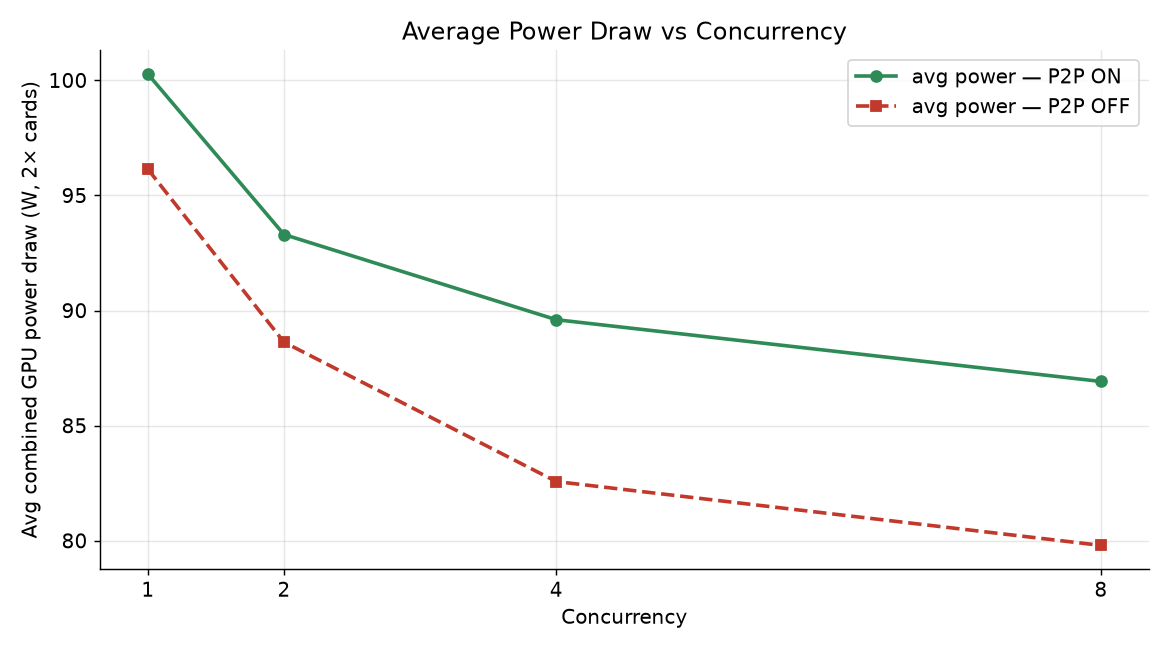
Tokens-per-joule = output tok/s ÷ mean combined GPU power. P2P ON is equal-or-better at every concurrency, and the whole rig tops out around 174–201 W for both cards combined. ⓘ evidence: power & tokens/joule
Proof that P2P is actually being used
This is the part that matters: P2P being “enabled” isn’t the same as P2P being used.
The benchmark captured a transport_proof.json for every scenario by parsing the live
NCCL debug logs, and the cuMem (NCCL_CUMEM_ENABLE=1) allocator path is what makes
direct peer mapping work on these consumer cards (ⓘ evidence).
P2P ON — NCCL maps channels directly over the bus via the cuMem allocator
(via P2P/CUMEM), with nccl_used_p2p: true, nccl_used_shm: false
(ⓘ evidence):
proxmox:1417089 [1] NCCL INFO NCCL_CUMEM_ENABLE set by environment to 1.
proxmox:1417089 [1] NCCL INFO Check P2P Type isAllDirectP2p 1 directMode 0 isAllCudaP2p 1
proxmox:1417089 [1] NCCL INFO Channel 00/0 : 1[2] -> 0[1] via P2P/CUMEM
proxmox:1417088 [0] NCCL INFO Channel 00/0 : 0[1] -> 1[2] via P2P/CUMEM
P2P OFF — same cuMem allocator, but with NCCL_P2P_DISABLE=1 NCCL falls back to the
shared-host-memory staging path (via SHM/direct/direct), nccl_used_p2p: false
(ⓘ evidence):
proxmox:1495819 [0] NCCL INFO NCCL_P2P_DISABLE set by environment to 1
proxmox:1495819 [0] NCCL INFO Check P2P Type isAllDirectP2p 0 directMode 0 isAllCudaP2p 1
proxmox:1495819 [0] NCCL INFO Channel 00 : 0[1] -> 1[2] via SHM/direct/direct
The CUDA P2P bandwidth/latency sample (captured in
p2p_evidence.json) confirms the two 5060 Ti’s
(devices 1 & 2) CAN access each other as peers (ⓘ evidence),
and that P2P writes cut the inter-GPU latency dramatically (e.g. 18.08 µs → 0.42 µs on the
GPU1↔GPU2 path once P2P is enabled — ⓘ evidence).
⚠️ “But the cuda-samples bandwidth is the same with P2P on and off — isn’t that the red flag that P2P isn’t engaging?”
Fair question, and worth addressing head-on because this harness’s own README says “if P2P=Enabled bandwidth ≈ P2P=Disabled, P2P is not engaging.” In the
p2pBandwidthLatencyTestoutput, the GPU1↔GPU2 bandwidth is indeed ~3.5 GB/s in both the disabled and enabled matrices — but that is expected here and is not evidence that P2P is off, for two reasons:
- The link is the ceiling, not P2P. PCIe Gen3 x4 ≈ 3.9 GB/s one-way (see the PCIe section below). The ~3.5 GB/s measured is essentially that link saturated. P2P writes don’t raise the ceiling of a host-bridge (
PHB) PCIe path — they remove the host-memory bounce, which shows up as latency, not peak bandwidth. And the latency does collapse (18.08 µs → 0.42 µs), which is exactly the P2P signature.- The transport is proven independently. The “red flag” rule is about the torch/ cuda-samples bandwidth probe being the only signal. Here we don’t rely on it — the NCCL channel-init logs explicitly show
via P2P/CUMEM(P2P on) vsvia SHM/direct/direct(P2P off), parsed intotransport_proof.json(nccl_used_p2p: truevsfalse). That is direct, unambiguous proof that the two arms use different transports — which is what actually matters for the benchmark.So the equal bandwidth is the link speaking, while the latency drop and the NCCL transport proof are what establish P2P is genuinely engaging.
You can verify all of this yourself (data lives under
p2p-bench/results/2026-06-16_5060ti-16gb_2cards_gen3-x4_p2p-sweep-c1-2-4-8/):
- Per-scenario transport proof:
scenarios/p2p_on-c1/transport_proof.jsonvsscenarios/p2p_off-c1/transport_proof.json - Raw NCCL logs:
logs/p2p_on-c1.log·logs/p2p_off-c1.log - Full P2P evidence dump:
env/p2p_evidence.json
PCIe link state — why this is Gen3 x4 (and not Gen4)
Every telemetry sample across all 8 scenarios reports the same PCIe link state for both 5060 Ti’s:
| Field | Value |
|---|---|
pcie.link.gen.current |
3 |
pcie.link.gen.max |
3 (as negotiated/reported under this topology) |
pcie.link.width.current |
x4 |
pcie.link.width.max |
x16 (slot/root-port max — see note below) |
So during this run each RTX 5060 Ti was running at PCIe Gen3 x4 — i.e. 4 lanes per card over OCuLink.
A note on
width.max = x16: that field reports the slot/root-port maximum, not the GPU’s own capability. The RTX 5060 Ti is physically a PCIe x8 device, so its real ceiling on this platform is x8 — and over the OCuLink adapter it negotiated x4. If anything this strengthens the takeaway below: these cards never needed x16 lanes for inference, and x4 was not the bottleneck.
This is the link state recorded directly in
the telemetry.csv files
(ⓘ evidence) and confirmed live via nvidia-smi on the host
(ⓘ evidence).
⚙️ Gen4 wasn’t achievable on this run — and I’m troubleshooting it
I was targeting Gen4 x4 over OCuLink, but the link trained down to Gen3 for this benchmark. I believe this is a signal-integrity / cable-length issue on the OCuLink path (it currently needs a retimer at the present cable length). I’m actively troubleshooting it. The good news: because this is inference-only, the inter-GPU all-reduce volume is small, so even Gen3 x4 still shows a clean P2P win (see below). See Future work for the Gen4 / 4-card plans.
What the telemetry tells us
Each scenario logged nvidia-smi telemetry once per second across all 3 iterations
(telemetry.csv, telemetry_run2.csv, telemetry_run3.csv). Fields:
pcie.link.gen.current/max, pcie.link.width.current/max, temperature.gpu,
utilization.gpu, utilization.memory, memory.used, power.draw,
clocks.current.sm, clocks.current.memory.
Aggregated per scenario (both 5060 Ti’s, all 3 iterations combined):
| Scenario | PCIe | Width | Max temp °C | Avg temp °C | Max GPU util % | Avg util % | Peak power (per card) | Avg power | Max mem used (MiB) | Max SM clock (MHz) |
|---|---|---|---|---|---|---|---|---|---|---|
| p2p_off-c1 | Gen3 | x4 | 63 | 53 | 100 | 94 | 106 | 96 | 13921 | 2812 |
| p2p_off-c2 | Gen3 | x4 | 63 | 53 | 100 | 95 | 104 | 89 | 14103 | 2812 |
| p2p_off-c4 | Gen3 | x4 | 62 | 52 | 100 | 96 | 104 | 83 | 14661 | 2827 |
| p2p_off-c8 | Gen3 | x4 | 63 | 51 | 100 | 97 | 104 | 80 | 14793 | 2820 |
| p2p_on-c1 | Gen3 | x4 | 64 | 55 | 100 | 94 | 109 | 100 | 13935 | 2812 |
| p2p_on-c2 | Gen3 | x4 | 63 | 53 | 100 | 94 | 109 | 93 | 14127 | 2812 |
| p2p_on-c4 | Gen3 | x4 | 63 | 53 | 100 | 95 | 108 | 90 | 14647 | 2812 |
| p2p_on-c8 | Gen3 | x4 | 64 | 52 | 100 | 96 | 108 | 87 | 14779 | 2812 |
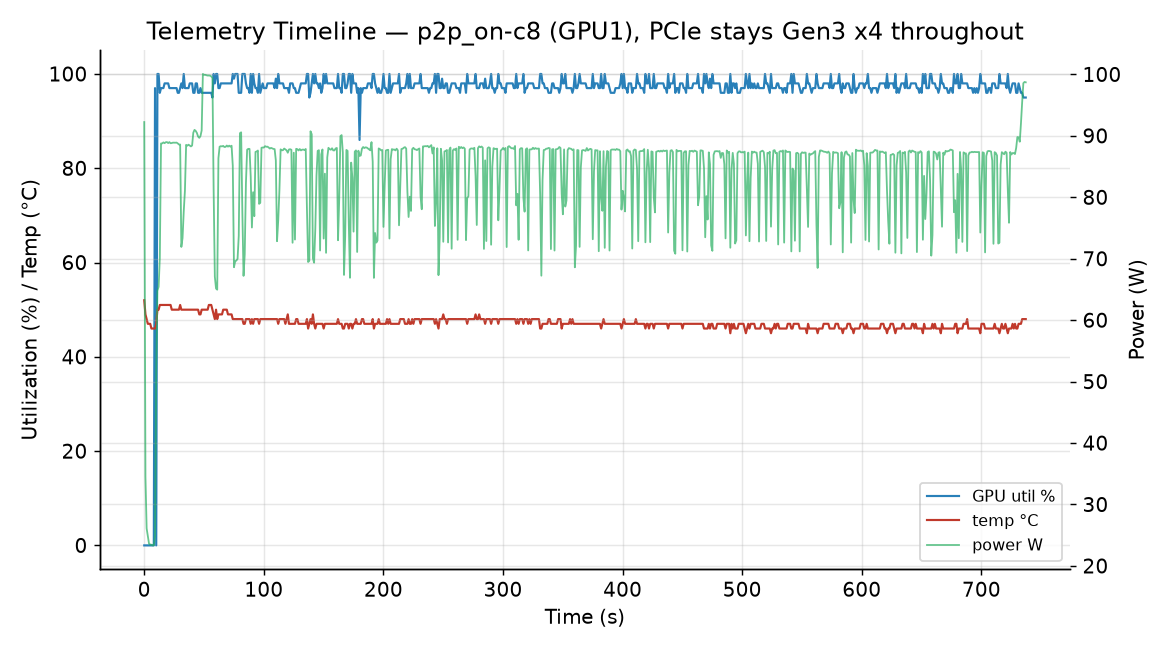
Sample timeline (p2p_on-c8, GPU1) — utilization, temperature and power over the run:
What we can glean:
- Temperature: Rock-solid and cool. Peaks at 62–64 °C, averaging ~51–55 °C. These cards are nowhere near thermal limits — no throttling is happening, so the throughput numbers are not thermally constrained. ⓘ evidence
- PCIe link: Pinned at Gen3 x4 the entire time, in every single scenario. This is the baseline we’re benchmarking against, and why the Gen4 follow-up matters. ⓘ evidence
- GPU utilization: 94–97 % average, frequently hitting 100 %. The GPUs are the bottleneck (compute-bound), which is exactly what you want — the PCIe link is not saturating at these inference concurrencies. ⓘ evidence
- Power: Peak ~104–109 W per card, averaging ~80–100 W. Note the average power drops as concurrency rises (96 W → 80 W at c8) because more time is spent in batched compute and less in idle gaps between requests — and the rig as a whole stays well under the cards’ rated TGP. Both cards combined draw under ~210 W in the worst case. ⓘ evidence
- Memory: Up to ~14.8 GiB used per card at c8 — comfortably inside the 16 GB
budget at
max-model-len=65535andmax-num-batched-tokens=16384. ⓘ evidence - SM clocks: Steady ~2.8 GHz, consistent with no throttling. ⓘ evidence
Raw per-scenario power summaries are in each scenario’s
power_run*.json and the full telemetry CSVs
are linked in the Raw data index.
Is P2P even worth it for my use case?
My use case is pure inference — no fine-tuning, no training, no gradient all-reduce, no multi-GPU optimizer state syncing. It’s just serving a single quantized model with TP=2.
As a single user, my realistic concurrency rarely climbs above 4–5 simultaneous requests, and almost never higher. The benchmark deliberately brackets that: c1, c2, c4, c8.
Here’s the key insight from the data: at inference time the only meaningful inter-GPU traffic is the tensor-parallel all-reduce of activations between layers. That’s small and bursty compared to training. The telemetry backs this up — the GPUs sit at 94–97 % utilization while the PCIe Gen3 x4 link never becomes the bottleneck. If the link were saturating, P2P-vs-SHM would show a much larger gap and utilization would dip; instead we see a modest-but-consistent +8–14 % improvement that comes from cutting the host-memory staging hop (and the ~18 µs → sub-µs peer latency), not from raw bandwidth.
Conclusion: for single-user, inference-only workloads at ≤ ~5 concurrency, the P2P bandwidth requirement is minimal, and even a Gen3 x4 link is more than enough — which makes this dual-5060-Ti setup very viable. P2P still helps (free 8–14 %), it just isn’t bandwidth-starved.
(If you think this reasoning is wrong or incomplete — e.g. if you have data showing the link does become a bottleneck at higher batch sizes or longer contexts — please open an issue; I’d genuinely like to be corrected.)
System, driver & patched kernel-module details
Hardware
Hardware evidence: ⓘ CPU/RAM/OS/kernel · ⓘ devices & topology.
| Component | Spec |
|---|---|
| Motherboard | ASUS TUF Gaming X570-Plus (Wi-Fi) |
| CPU | AMD Ryzen 9 3900X (12C / 24T) |
| RAM | 64 GB DDR4 @ 2133 MT/s (SPD/dmidecode) |
| GPUs (under test) | 2× NVIDIA GeForce RTX 5060 Ti 16 GB (devices 1 & 2, bus 09:00.0 / 0A:00.0) |
| Other GPU present | 1× RTX 5070 (device 0, bus 04:00.0) — not used in this benchmark (CUDA_VISIBLE_DEVICES=1,2) |
| GPU interconnect | PCIe Gen3 x4 per card over OCuLink (topology PHB — traverses the PCIe host bridge; no NVLink) |
| Host OS | Proxmox VE on Debian 13 (trixie), kernel 6.17.13-13-pve |
The two 5060 Ti’s connect peer-to-peer through the CPU’s PCIe host bridge (PHB in the
nvidia-smi topo matrix) — there is no NVLink on these cards, so PCIe P2P is the only direct
path, which is exactly what this benchmark exercises. ⓘ evidence
NVIDIA driver & the patched P2P kernel modules
Consumer GeForce cards don’t expose P2P with the stock driver. To enable it I built the
community open GPU kernel modules with the P2P patch — specifically
aikitoria/open-gpu-kernel-modules
(the geohot/tinygrad-style P2P enablement, extended for the RTX 5090/Blackwell generation),
checked out on the Proxmox host at /data/open-gpu-kernel-modules. Evidence:
ⓘ base driver 595.71.05 ·
ⓘ patched module repo ·
ⓘ peermem not loaded · ⓘ CUDA 13.2.
| Item | Value |
|---|---|
| Base NVIDIA driver installed (userspace) | 595.71.05 |
| Patched open kernel modules | aikitoria/open-gpu-kernel-modules (version.mk: NVIDIA_VERSION = 595.71.05) |
Module repo git describe |
550.67-39-g860df942 |
| Relevant commit | 97fdda09 Combined P2P mod based on the one by geohot, 5090 support by nimlgen, NVLink support by valdemardi |
modinfo nvidia version |
595.71.05 (open kernel module, license: Dual MIT/GPL, supported: external) |
/proc/driver/nvidia/version |
NVIDIA UNIX Open Kernel Module ... 595.71.05 ... (root@proxmox) — i.e. locally built |
| CUDA toolkit | nvcc release 13.2, V13.2.51 |
| NCCL | 2.28.9 (ⓘ) |
nvidia_peermem loaded |
false (not needed — P2P here is via the cuMem allocator + patched module, not GPUDirect RDMA) (ⓘ) |
In short: I installed the 595.71.05 userspace driver first, then built and installed the matching patched open kernel modules (P2P-enabled, from
aikitoria/open-gpu-kernel-modules, NVIDIA_VERSION 595.71.05) on top of it. The README of that repo literally states “NVIDIA driver 595.71.05 with P2P for RTX 3090, RTX 4090, and RTX 5090”. The loaded modules are:nvidia,nvidia_uvm,nvidia_modeset,nvidia_drm(seekernel_modules.txtandlsmod_full.txt).
Full driver/version evidence: p2p_evidence.json ·
host_summary.json ·
dmesg_gpu.txt.
Boot, GRUB & sysctl tuning captured at runtime
The automation snapshotted the live kernel/sysctl state during the benchmark so the environment is fully documented.
Kernel command line / GRUB (from kernel_cmdline.txt,
ⓘ evidence):
# /proc/cmdline
BOOT_IMAGE=/boot/vmlinuz-6.17.13-13-pve root=/dev/mapper/pve-root ro \
  drm_kms_helper.bfdev_emulation=0 quiet iommu=pt pcie_aspm=off amd_iommu=on

# /etc/default/grub
GRUB_CMDLINE_LINUX_DEFAULT="quiet iommu=pt pcie_aspm=off amd_iommu=on"
GRUB_CMDLINE_LINUX=""
Notable params and why they matter for this build:
pcie_aspm=off— disables PCIe Active State Power Management so the link doesn’t drop into low-power L-states mid-transfer; important for stable P2P latency.iommu=pt/amd_iommu=on— IOMMU in pass-through mode: keeps DMA remapping out of the hot path while leaving the IOMMU available (useful on this Proxmox host).drm_kms_helper.bfdev_emulation=0— display/KMS tweak for the headless-compute setup.
sysctl (from sysctl.txt, ⓘ evidence):
vm.nr_hugepages = 0
kernel.numa_balancing = 0      # NUMA balancing off — avoids the kernel migrating pages
vm.zone_reclaim_mode = 0       # don't aggressively reclaim from the local zone
kernel.yama.ptrace_scope = 1
kernel.numa_balancing = 0 and vm.zone_reclaim_mode = 0 keep memory placement stable
during long runs (no surprise page migrations on this single-socket Ryzen).
Cost breakdown — why this is a budget build
This was built on top of my 2020 gaming desktop — I only had to buy the two GPUs and a bit of OCuLink gear.
| Item | Cost (USD) |
|---|---|
| 2× RTX 5060 Ti 16 GB @ $500 each | $1,000 |
| OCuLink adapters / cables / gear | ~$150–200 |
| Everything else (X570 board, Ryzen 9 3900X, 64 GB RAM, PSU, case) | $0 (already owned, built 2020) |
| Total incremental spend | ~$1,150–1,200 |
How that compares to “the usual” single-card options
Using current used market prices for the cards people usually reach for:
| Card | Used price (single) | VRAM |
|---|---|---|
| RTX 3090 | ~$1,450 | 24 GB |
| RTX 4090 | ~$2,900 | 24 GB |
| RTX 5090 | ~$3,900 | 32 GB |
| 2× RTX 5060 Ti (this build) | $1,000 total | 32 GB total (16+16) |
For $1,000 of GPU I get 32 GB of aggregate VRAM and, with this model, I can run:
Qwen3.6-27B-Text-NVFP4-MTPat 120K context at lower concurrency withmax-num-batched-tokens=8192, or- 64K context at concurrency 1/2/4/8 with
max-num-batched-tokens=16384,
…at the tokens-per-second recorded above (up to ~191 output tok/s at c8 with P2P on). For a single-user, inference-only workload, that makes this a super viable budget build — well under the price of a single used 3090, and far cheaper than a 4090/5090, while delivering usable throughput and 32 GB of VRAM headroom.
Reproduce it yourself
The entire benchmark — scenario matrix, AB-AB-AB scheduling, telemetry capture, NCCL
transport proofing, power integration, and plotting — was driven by a Python automation
harness, p2pbench, which ships in this same repository.
🔧 Benchmark software: https://github.com/joorklee/p2p-bench → the
p2p-bench/directory.
Install
git clone https://github.com/joorklee/p2p-bench
cd p2p-bench/p2p-bench
pip install -r requirements.txt      # run this inside your working vLLM venv
You also need llama-swap on your PATH,
a vLLM venv that already serves your model by hand, and (recommended) the cuda-samples
p2pBandwidthLatencyTest binary for authoritative P2P proof.
Run the sweep
RUN=results/myrig_2cards_$(date +%Y%m%d)

# 0) FIRST: confirm device order and that P2P is actually engaging on your rig.
#    If P2P=Enabled bandwidth ≈ P2P=Disabled, P2P isn't working — fix the driver
#    (e.g. the patched open kernel modules) before benchmarking.
python -m p2pbench --output-dir "$RUN" \
    --p2p-test-bin ~/cuda-samples/.../p2pBandwidthLatencyTest check-env

# 1) full pipeline: env capture -> smoke -> warmup -> 3 interleaved timed reps
#    (AB-AB-AB) -> aggregate (mean±std) -> summary tables + plots
python -m p2pbench --output-dir "$RUN" run
The commands at a glance
| Command | What it does |
|---|---|
check-env |
Captures host env + P2P evidence (nvidia-smi topo, cuda-samples test, torch probe); verifies device order. Run first. |
gen-config |
Emits the llama-swap.config.yaml from the scenario matrix and exits. |
smoke |
Boots each scenario + a 1-token request to catch failures before the long run. |
run |
The full timed pipeline (the one that produced these results). |
report |
Re-renders summary.* + plots/ from existing data (no GPUs needed). |
Useful options: --scenarios PATH (pick a rig config), --include-optional-arm
(adds the customAR+P2P 3-way decomposition), --reps N, --skip-smoke, --force.
The exact config used for this report is archived at
config/5060ti-16gb/2-cards/gen3-x4-3.9GBps/scenarios.yaml; reproduce it with:
python -m p2pbench \
    --scenarios config/5060ti-16gb/2-cards/gen3-x4-3.9GBps/scenarios.yaml \
    --output-dir "$RUN" run
Methodology that makes the numbers trustworthy
The harness deliberately changes only NCCL_P2P_DISABLE between the two arms —
NCCL_CUMEM_ENABLE=1 and --disable-custom-all-reduce are held constant in both, so
NCCL is the communicator in both and the env var actually controls the transport
(otherwise vLLM’s custom all-reduce uses its own CUDA peer check and would silently
keep using P2P even in the “off” arm). Workloads are fixed-length/deterministic, reps
are interleaved (AB-AB-AB) to cancel thermal drift, and clocks/temps are logged per
second so throttled runs can be discarded. Full rationale in the
p2p-bench README.
Organizing configs & naming runs
- Configs are archived per-rig at
config/<gpu-model>/<n-cards>/<link-bandwidth>/scenarios.yaml(e.g.5060ti-16gb/2-cards/gen3-x4-3.9GBps/), where<link-bandwidth>names the effective PCIe link the run trained at, labelled by its theoretical max one-way bandwidth. - Runs (
--output-dir) followresults/<date>_<gpu-model>_<n-cards>_<link-bandwidth>_<what-was-swept>— e.g. this report’s data is2026-06-16_5060ti-16gb_2cards_gen3-x4_p2p-sweep-c1-2-4-8/. Each run directory is fully self-contained (config snapshot + env + telemetry + logs + aggregates + plots), so it can be audited in isolation.
The data backing this exact report lives in this same repository under
2026-06-16_5060ti-16gb_2cards_gen3-x4_p2p-sweep-c1-2-4-8/ (and in the harness at the descriptively-named result set above),
so every number above is independently checkable.
Future work
I plan to re-run this identical scenario matrix (P2P on/off × c1/c2/c4/c8 × 3 iterations) under additional configurations:
- Gen4 × 2 cards — once the shorter OCuLink cables arrive (hopefully no retimer needed) to compare Gen4 x4 vs the Gen3 x4 baseline here.
- Gen3 × 4 cards — scaling out to 4 GPUs on the Gen3 fabric.
- Gen4 × 4 cards — the full target configuration (a quad-5060-Ti OCuLink rig in the
spirit of this r/LocalLLM build
that inspired this project; see also
5p00kyy/club-5060ti).
I’m currently troubleshooting the Gen4 link training (it dropped to Gen3 for this run) and waiting on shorter OCuLink cables to try to hit Gen4 x4 without a retimer.
About me & a request
I work in IT as a cloud systems engineer and have been in the industry for about a decade — but I only recently started getting into running LLMs locally. So if I’ve gotten any terminology, methodology, or interpretation wrong here, I apologize in advance.
If anything in this report is incorrect or misleading, please open a GitHub issue so I can correct and address it. I’d much rather publish accurate numbers than impressive-looking ones.
Raw data index
📑 Prefer a guided tour? The Evidence Appendix maps each claim in this report to its source file with an inline excerpt.
All source data for this report lives in one self-contained result set:
p2p-bench/results/2026-06-16_5060ti-16gb_2cards_gen3-x4_p2p-sweep-c1-2-4-8/
(paths below are relative to that directory):
Top-level summaries
summary.csvsummary.jsonsummary.mdllama-swap.config.yaml— exact vLLM launch commands & env per scenario
Environment / proof
env/p2p_evidence.jsonenv/host_summary.jsonenv/kernel_cmdline.txtenv/sysctl.txtenv/kernel_modules.txtenv/lsmod_full.txtenv/dmesg_gpu.txt
Per-scenario (aggregate.json, scenario.json, transport_proof.json,
run_{1,2,3}.json, power_run{1,2,3}.json, telemetry{,_run2,_run3}.csv):
| P2P ON | P2P OFF |
|---|---|
scenarios/p2p_on-c1/ |
scenarios/p2p_off-c1/ |
scenarios/p2p_on-c2/ |
scenarios/p2p_off-c2/ |
scenarios/p2p_on-c4/ |
scenarios/p2p_off-c4/ |
scenarios/p2p_on-c8/ |
scenarios/p2p_off-c8/ |
NCCL / vLLM logs
- P2P ON:
logs/p2p_on-c1.log·c2·c4·c8 - P2P OFF:
logs/p2p_off-c1.log·c2·c4·c8 logs/llama-swap.log
Original generated plots (from the harness)
plots/throughput_vs_concurrency.pngplots/p99_tpot_vs_concurrency.pngplots/p2p_gain_pct.pngplots/timeline_p2p_on-c1.png


Benchmark date: 2026-06-16. Host: Proxmox VE (LAN-local). Model:
Qwen3.6-27B-Text-NVFP4-MTP.
vLLM v0.23.0 · NCCL 2.28.9 · CUDA 13.2 · driver 595.71.05
(patched open kernel modules with consumer P2P).